










KIGALI, Rwanda – Esther’s Aid Vocational Training Center has graduated a new generation of culinary and vocational skills trainees, reaffirming its commitment to bridging the gap between education and employment while announcing plans to transform its Culinary Arts School into a university-level institution within the next two years.
The graduation ceremony, held in Kigali on Saturday, October 31, 2026, brought together students, parents, trainers, alumni, hospitality industry representatives, government officials and development partners to celebrate the achievements of trainees whose education has been shaped by practical skills, professional mentorship and industry collaboration.

The event celebrated 150 Culinary Arts students, 130 community women trained through a family nutrition programme and three Fashion Design and sewing trainees.
It also marked the formal induction of the graduating culinary students into Rwanda’s professional chef community through a ceremony led by the Rwanda Chefs Alliance.
For Esther’s Aid, the occasion represented more than the completion of training. It demonstrated how vocational education can create employment opportunities, encourage entrepreneurship, improve community wellbeing and prepare young people to participate in Rwanda’s growing hospitality industry.
From vocational training to professional employment
One of the strongest indicators of the school’s impact is the employment opportunities available to its graduates.
Through partnerships with leading hospitality establishments in Rwanda, Esther’s Aid reports that more than 90% of its Culinary Arts graduates have secured placements within the hospitality sector.

The institution also reports that approximately 30% of its alumni have obtained employment opportunities in different countries, demonstrating the international relevance of the professional skills acquired through its training programmes.
The school’s approach combines classroom instruction with practical experience, industry mentorship and professional connections, helping students transition from training institutions into workplaces.
Its partnerships include major hospitality establishments such as Kigali Serena Hotel, Marriott, Radisson, One&Only and Mythos, among others.

Addressing the graduates, Clare Effiong, Founder and Director of Esther’s Aid, described the institution’s work in Rwanda as a commitment to developing skills and expanding opportunities in the hospitality sector.
Esther’s Aid, which is based in the United States, has extended its development activities to communities in Rwanda, working with women, children and young people through education, nutrition and vocational training.
Effiong said the Culinary Arts programme was established to prepare young people for professional opportunities while contributing to the development of Rwanda’s hospitality industry.
She encouraged graduates to recognise the opportunities available in the sector, including employment and entrepreneurship.
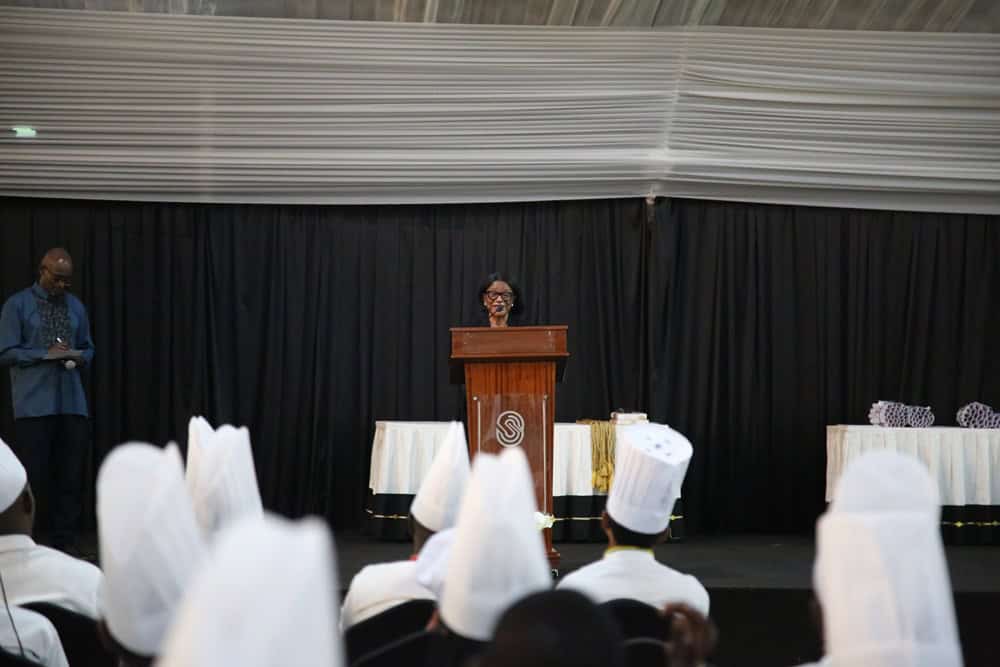
“The world out there is there for you. The kitchen is there for you,” she told the graduating students, acknowledging the discipline and resilience required to complete practical culinary training.
She also challenged them to become responsible citizens, emphasising that Rwanda needs their hard work, good character and commitment to national development.
“This country needs you. This country needs your behaviour, needs your good character. This country needs your hard work,” she said.
Effiong further encouraged graduates not to depend exclusively on formal employment but to consider establishing their own businesses and using their professional skills to become economically independent.
Government urges graduates to become job creators
The keynote government message was delivered by Ms. Agaba N. Bissengo, Deputy Director General of the Rwanda TVET Board at the Ministry of Education, who represented the Minister of Education.

She commended Esther’s Aid for its guiding principle, “We Love. We Care. We Train. We Empower,” describing the graduation as a demonstration of the transformative power of education and skills development.
“Education is not simply about imparting knowledge. It is also about restoring hope, building confidence, nurturing dignity, and enabling people to lead productive and independent lives,” Bissengo said.
She noted that Technical and Vocational Education and Training (TVET) remains an important pillar of Rwanda’s education and skills development agenda, particularly as the country seeks young people who can contribute to economic growth through employment and entrepreneurship.

Bissengo challenged graduates to embrace three important principles as they begin their professional journeys.
First, she encouraged them to cultivate reliability, creativity and continuous learning, explaining that professional reputations depend not only on knowledge but also on how effectively individuals apply their skills.
Second, she urged them to embrace entrepreneurship and innovation rather than limiting their ambitions to finding jobs.
She noted that skills in culinary arts, baking, fashion and hospitality could become the foundation of sustainable businesses when combined with sound business management and determination.

Finally, she encouraged graduates to believe in their potential and use their achievements to uplift their families and communities.
She recognised that some students had overcome personal, social and economic challenges to reach graduation, urging them to turn those experiences into motivation for future success.
Rwanda Chefs Alliance formally welcomes graduates
An important highlight of the ceremony was the professional induction of the graduating culinary students into the Rwanda Chefs Alliance.

Chef Innocent, President of the Rwanda Chefs Alliance, welcomed the graduates into a professional community comprising more than 2,000 junior and senior chefs.
He explained the different stages of professional development within a kitchen brigade, from Commis 1, 2 and 3 to Chef de Partie, Sous Chef, Senior Sous Chef, Executive Sous Chef, Executive Chef and Director.
Sharing his personal career journey, Innocent explained that he had initially studied Mathematics, Economics and Geography in Senior Six before obtaining a diploma in Accounting.
Although he had hoped to work in the banking sector, he was selected by the government in 1998 to pursue hospitality training at Kenya Utalii College.
His subsequent career included working as a cook during the opening of InterContinental, progressing to Executive Sous Chef at Marriott, and gaining international professional experience in Dubai and Malaysia. He also undertook training in Singapore and Beijing.

Using his experience to encourage the graduates, Innocent explained that professional cooking is a career with opportunities for continuous growth.
He also emphasised the responsibility attached to being a professional chef, particularly the importance of maintaining standards and respecting the profession.
“Your food tells your story,” he said, explaining that modern chefs must also become ambassadors of their products and communicate the value of their work to customers.
He subsequently led the graduates in taking their professional Chef’s Vow, marking their induction into the professional chef community.
Kigali Serena Hotel reaffirms partnership in hospitality training
The contribution of the private sector was another central theme of the graduation.
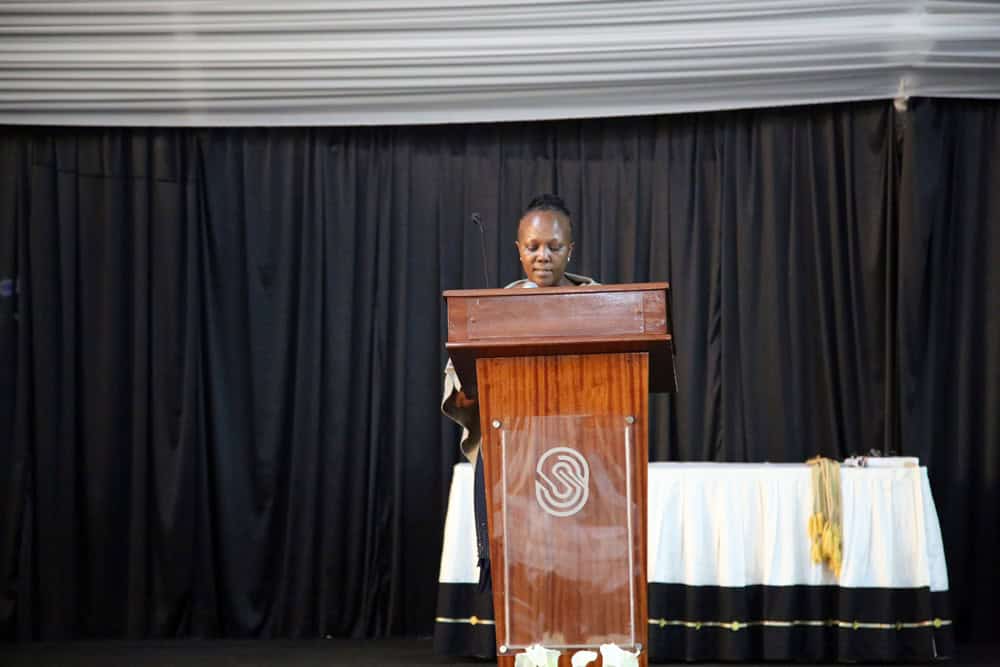
Representing Kigali Serena Hotel, one of Esther’s Aid’s important partners in internships and employment opportunities, Ms. Millicent congratulated the graduates on completing their training.
She attended the ceremony on behalf of the hotel’s General Manager, who was unable to attend.
In the hotel’s message, hospitality was described as more than providing accommodation, food and beverages. It involves creating memorable experiences, anticipating guest needs and ensuring that every guest feels valued.
Achieving this requires technical competence, teamwork, professionalism and a genuine passion for service.

The hotel representative said the partnership between Serena Hotel and Esther’s Aid reflected a shared commitment to developing talent and supporting the growth of Rwanda’s hospitality sector.
Effiong expressed special appreciation to Kigali Serena Hotel for its continued support, particularly for repeatedly providing its venue for Esther’s Aid events.
She specifically recognised Ms. Millicent and asked her to convey the institution’s gratitude to the General Manager and the hotel’s entire management and staff.
Effiong also recognised the Rwanda Chefs Alliance for its contribution to teaching, mentoring and advising students throughout their professional development.
RDB: Graduates are carrying Rwanda’s national flag
Mr. Nkusi Felly Karenzi, Head of Hospitality Quality at the Rwanda Development Board (RDB), welcomed the graduates into the hospitality industry and challenged them to understand the wider meaning of their profession.

He explained that hospitality extends beyond providing accommodation, food and beverages.
“Hospitality does not mean just accommodation and meals. It is making someone feel at home far from home. That is hospitality,” Karenzi said.
He encouraged graduates to pursue excellence and recognise that their professional conduct would influence how Rwanda is perceived internationally.
Whether working in Rwanda or pursuing opportunities in Dubai, the United States, South Africa or elsewhere, he reminded them that they would carry the country’s image through their behaviour and professionalism.

He urged them to represent both Esther’s Aid and Rwanda with distinction.
His message reinforced the importance of professional standards in an industry where customer experience, service quality and reputation are essential.
Alumni success demonstrates the long-term impact of training
The graduation also provided an opportunity to reflect on the long-term impact of Esther’s Aid through the experiences of its former students.
Mr. Karegesa Phenias, President of the Esther’s Aid Alumni Association and a member of the Class of 2012, shared his journey from being a disadvantaged student at the institution to building an international career in hospitality.
He has worked with One&Only Gorilla’s Nest and One&Only Nyungwe House, establishments operating under Kerzner International Hotels.

His experience demonstrated how vocational training can create opportunities that extend far beyond the classroom.
Phenias also highlighted the alumni association’s commitment to giving back, particularly by supporting disadvantaged commu nities and individuals who cannot afford vocational training.
He said the alumni wanted to continue the spirit of support they had received from Esther’s Aid and Clare Effiong, whom they affectionately call Mama Claire.

During the ceremony, the alumni presented a special gift to Effiong in recognition of her motherly support and continued commitment to their development.
The gesture illustrated how the institution’s impact extends beyond the immediate beneficiaries of its programmes, creating a network of former students committed to supporting others.
Culinary skills also contribute to fighting malnutrition
Beyond employment and professional development, Esther’s Aid is using practical training to address community challenges, particularly nutrition and child malnutrition.

Florence Umutoni, a Women Nutrition Ambassador, challenged graduates to apply their culinary knowledge to improve household nutrition and contribute to Rwanda’s efforts to address child stunting.
She highlighted the importance of using affordable, locally available foods to prepare nutritious meals, demonstrating that healthy cooking does not necessarily require expensive ingredients.
“People are praising us for how we have learned to cook economically – using little money, using what we have. Even dodo!” Umutoni said.
She explained that ingredients sometimes overlooked by households can be transformed into nutritious and attractive meals when people acquire the right knowledge and cooking skills.
Her message highlighted the connection between vocational culinary training, food security, family nutrition and public health.
Esther’s Aid’s family nutrition programme has trained 130 community women, equipping them with practical knowledge to prepare healthier meals using locally available resources.
Graduates celebrate a journey of discipline, creativity and friendship
Representing her fellow graduates, Umukumburwa Queen Kevine delivered an emotional address reflecting on the experiences and personal growth of the students.

She said the journey had brought together individuals from different backgrounds and with different ambitions, but the shared training experience had transformed them into a close community.
She explained that the Culinary Arts programme taught students much more than preparing food.
It developed patience when things went wrong, discipline during demanding practical sessions and creativity when facing challenges.
Kevine thanked instructors, mentors, parents and families for their guidance and encouragement throughout the programme.

She reserved special appreciation for Clare Effiong, whom she affectionately called Mama Claire, recognising her continued prayers, kindness and support.
Looking ahead, she encouraged fellow graduates to embrace different professional pathways, including becoming chefs, opening restaurants, establishing businesses and exploring opportunities they might not yet have imagined.
She reminded them not to be discouraged by starting small.
“Every great chef once started with their first dish, and every business once started with an idea, and every beautiful journey starts with one step,” she said.
Her message captured the aspirations of a graduating generation preparing to move from vocational training into professional life.
Esther’s Aid targets transformation into a Culinary University
While celebrating the achievements of its graduates, Esther’s Aid is already looking towards a more ambitious phase of institutional development.
Effiong announced plans to upgrade the existing School of Culinary Arts into a Culinary University within approximately two years.
The proposed transformation is intended to establish a higher-level centre of excellence for culinary education, hospitality training, professional development, research and collaboration with the hospitality industry.
The ambition is to position Rwanda as an important destination for advanced culinary and hospitality education, while creating opportunities for students and professionals beyond the country’s borders.
However, the institution faces an important challenge: construction of its educational infrastructure project has been paused because of insufficient funding.
Completing the infrastructure will be essential to supporting the institution’s expansion and its ambition to provide training at a higher level.

The planned development therefore presents an opportunity for government institutions, hospitality businesses, development partners, foundations, philanthropists and other potential investors to support an initiative that connects education directly with employment and community development.
For Esther’s Aid, the next phase is not simply about expanding a school. It is about building an institution capable of preparing more young people for professional opportunities, encouraging entrepreneurship and strengthening Rwanda’s hospitality workforce.
A graduation that looks beyond certificates
The 2026 graduation has demonstrated the different ways vocational education can influence individuals and communities.
From culinary graduates entering the hospitality profession to women applying nutrition knowledge in their households, and alumni returning to support disadvantaged communities, Esther’s Aid’s work reflects an approach that combines skills development with social responsibility.

Its reported employment outcomes also demonstrate the importance of collaboration between training institutions and employers in ensuring that education responds to the actual needs of the labour market.
As the graduates begin their professional journeys, the institution’s next challenge is to secure the support required to complete its educational infrastructure and realise its Culinary University ambition.
The message emerging from the ceremony is clear: vocational education must not end with certificates. It should create pathways to decent work, entrepreneurship, dignity and sustainable development.
For Esther’s Aid, that journey continues with a commitment captured in its guiding principle: We Love. We Care. We Train. We Empower.