










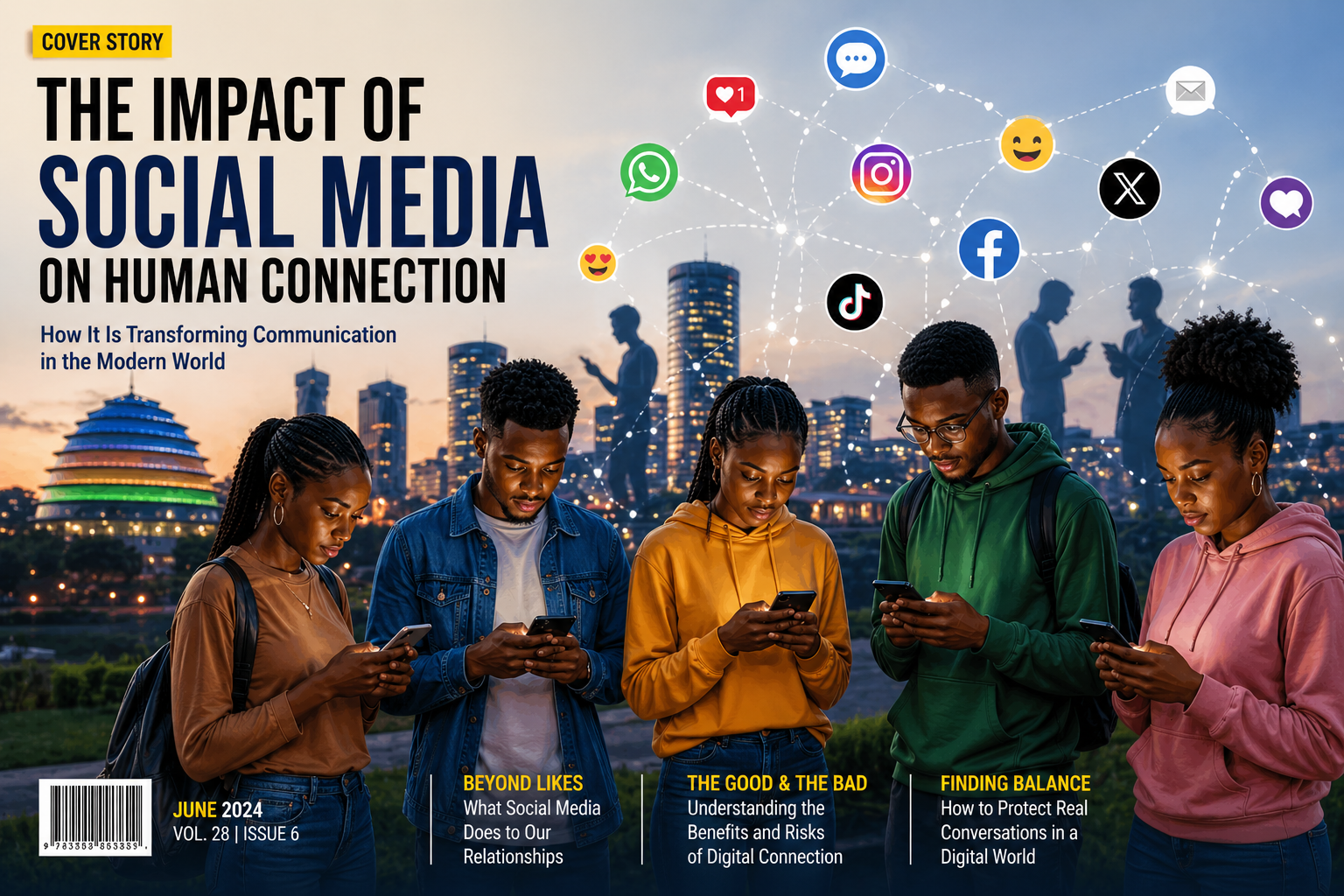
Over the past decade, social media platforms have significantly transformed the way people communicate, build relationships, and maintain connections with family and friends. In major cities such as Kigali and around the world, many people now rely more on their phones and social media platforms to communicate than on face-to-face interactions. Platforms such as WhatsApp, Instagram, TikTok, Facebook, and X (formerly Twitter) allow messages to reach someone within seconds, regardless of where they are in the world. This has made communication easier within families, businesses, and in the dissemination of information.
However, communication researchers say that although these platforms make it easier for people to communicate, noticeable changes are emerging in how people socialize and interact. A 2024 report by DataReportal shows that more than five billion people worldwide use social media, representing nearly 60 percent of the global population. The report also indicates that, on average, a person spends about 2 hours and 20 minutes per day on social media.
Researchers say this rapid increase in social media usage is contributing to significant changes in the way people communicate. A study conducted by Pew Research Center in 2023 found that many young people now rely heavily on text messages, emojis, and voice notes to communicate with friends.
Researchers note that while this form of communication is fast and convenient, it may also reduce the depth and length of conversations. Communication scholar Professor Sherry Turkle of the Massachusetts Institute of Technology explains that technology is changing the way people interact.
She stated:
“Technology allows us to communicate more, but sometimes it can reduce the depth of conversations between people.”
Some studies suggest that excessive use of social media may affect people’s ability to engage in face-to-face communication.
Research published in 2023 in an academic journal on education and communication found that people who spend long periods on social media may experience changes in:
• their ability to understand other people’s emotions
• their ability to interpret messages in face-to-face conversations
• their capacity to sustain longer discussions
However, researchers emphasize that this is not true for everyone, as other studies show that social media can also strengthen social connections. In traditional face-to-face communication, people use several elements to interpret meaning, including body language, facial expressions, tone of voice, and the way words are spoken.
Communication researcher Professor Joseph Walther, one of the leading scholars in the study of online communication, explains: “Online communication can sometimes lead to misunderstandings because it lacks the physical cues that help convey emotions.”
Despite concerns about its potential effects, researchers agree that social media plays an important role in maintaining relationships between people who live far apart.For families with members living abroad or in different countries, social media platforms enable them to communicate more frequently than was possible in the past.Research conducted by the Oxford Internet Institute found that social media can help people maintain friendships and family relationships across long distances, especially during periods of migration and international employment. Many researchers agree that social media does not produce purely negative or purely positive effects; rather, it creates a mixture of both. On one hand:
- it makes communication easier
- it allows information to spread quickly
- it helps maintain relationships between people who live far apart
On the other hand:
- it may reduce the length of conversations
- it may decrease face-to-face interactions
- it may increase the risk of misunderstandings
Social media has fundamentally changed how people communicate in the modern world. While it facilitates communication and connects people globally, researchers say it remains essential to continue valuing face-to-face interaction. As communication experts emphasize, the main issue is not technology itself, but how people choose to use it.
Finding a balance between digital communication and traditional interpersonal interaction may help preserve the depth and quality of human relationships in an increasingly technological world.